Kyoto, Day 1
Saori
Another language exchange friend, Saori, met me when I arrived at Kyoto station. She and I had only ever exchanged written messages, never Skyped, so I was especially excited to meet her. She is from Osaka. She took the day off from work to take a train to Kyoto to meet me for lunch.
I was very thankful not just for that, but for the fact that she offered to take a cab to the Ryokan with me so I could leave my luggage there. The Ryokan was not well known and some of the streets are closed to cars, so the taxi driver had difficulty. Saori was able to explain the directions and help me find the place.
Saori also made a reservation at a very famous tofu restaurant nearby so we could walk to lunch.
Tofu lunch
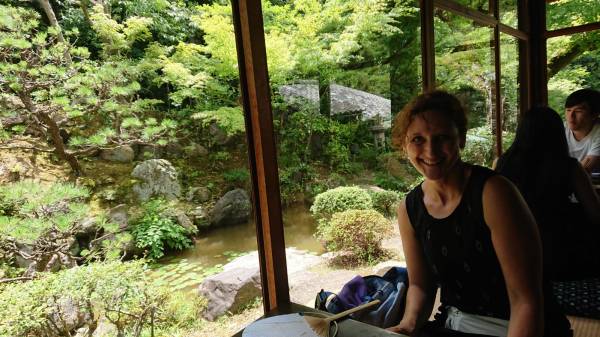
We were seated near the window looking out on a beautiful garden. Saori asked if I wanted hot or cold tofu (definitely cold as the outside temperature was near 100 F!!) and then ordered for both of us.
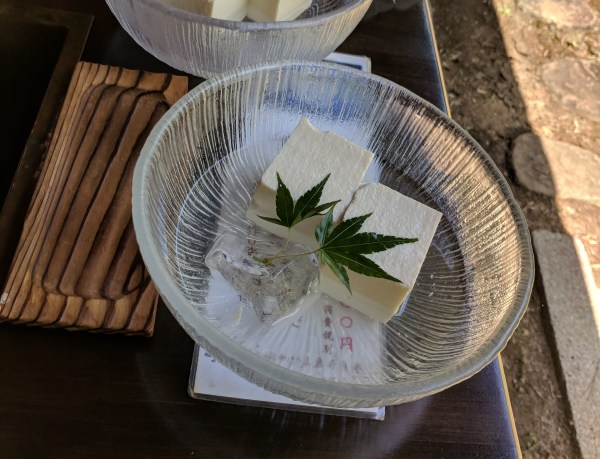
The first course was soft sesame tofu with a small amount of wasabi on top. This was probably my favorite course, though everything that came after was wonderful.
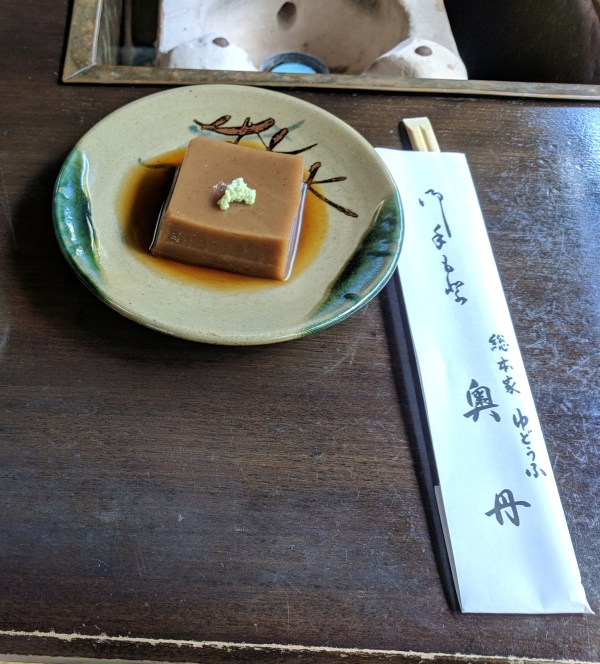
Sesame tofu. Chopstick wrapper with restaurant name.
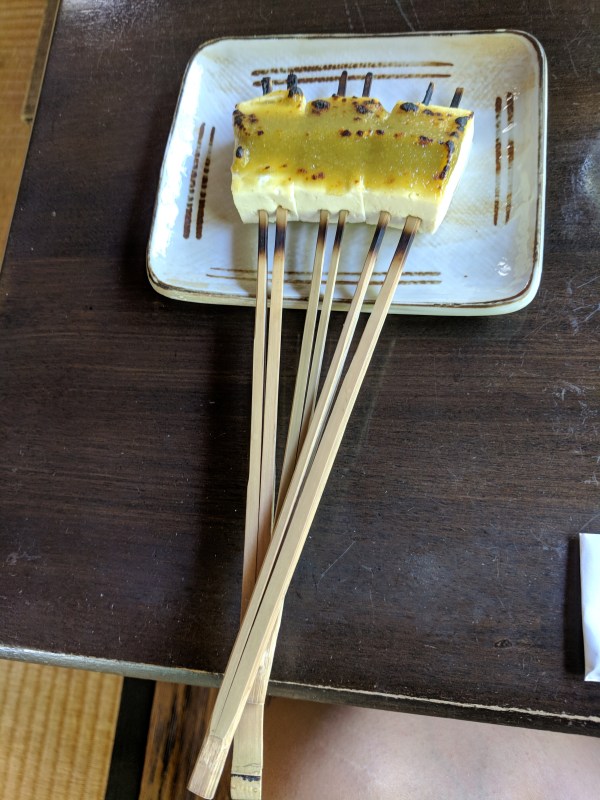
The second course was grilled tofu on a stick with some kind of purée sauce.
Then bowls of cold tofu in ice water with shoyu sauce, green onion and ginger to put on top. This was accompanied by a plate of tempura (Japanese basil, seaweed, mushroom, Shishido (pepper), and potato. There was a separate dipping sauce for the tempura.
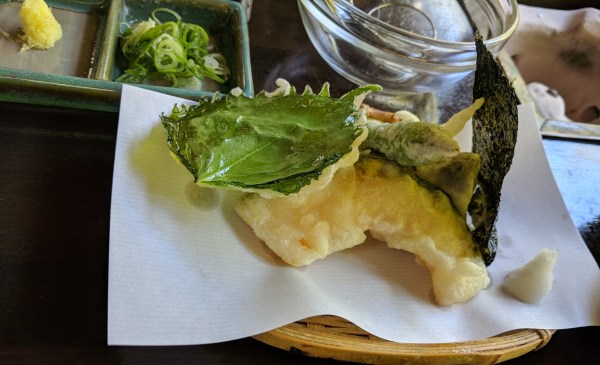
We broke of pieces of tofu with our chopsticks and used a tiny strainer to drain the tofu and place it in an empty bowl. Then we topped it with scallions, ginger and shoyu. It was so delicious, I had to eat all of it even though it was a lot of food.
The last course was rice, pickles and young potato (a mashed sticky starch to pour over the rice).
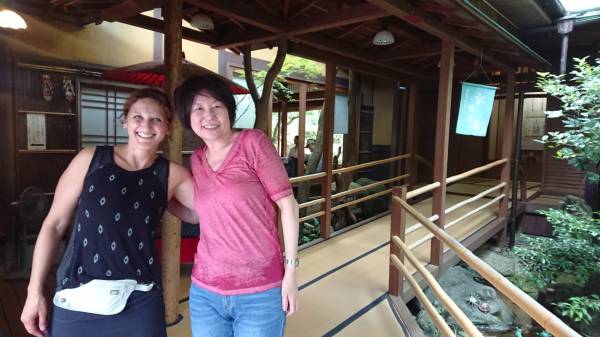
Saori treated me despite my protests. The hostess took a photo of us before we left.
Restaurant link: http://www.tofuokutan.info
Kanji Museum
After lunch Saori suggested we walk to the Kanji Museum nearby. I have been studying Kanji for a couple of years now, so I was very interested to go. Also escaping the heat in an air conditioned museum was not unappealing.
The exhibits were entirely in Japanese, but geared towards people of all ages. There were simple explanations of the history for kids visiting and then lengthier verbiage for adults. I could understand almost all of the information geared towards kids, so it was perfect for me.
There were also kids activities – a little booklet to fill out as you went through the museum. I wasn’t sure how Saori would feel about it, but she enjoyed visiting the different stations, getting stamps and playing games.
If you are not familiar with the Japanese language, there are 3 alphabets in Japanese. Hiragana and Katakana are both phonetic. Katakana is used primarily for foreign words that have been adopted into Japanese. For example, is pronounced mee-roo-koo (Milk).
The third set of symbols, Kanji, is not phonetic. Kanji are the Chinese symbols that are used to build words in Japanese. Most Kanji have at least two different pronunciations: one used when combined with other kanji to make a word; one used when combined with Hiragana characters.
At the museum I learned that the Hiragana characters actually came from simplifications of some of the Kanji characters. Unfortunately, I couldn’t understand much more than that from the museum displays because, paradoxically, I don’t know enough Kanji.
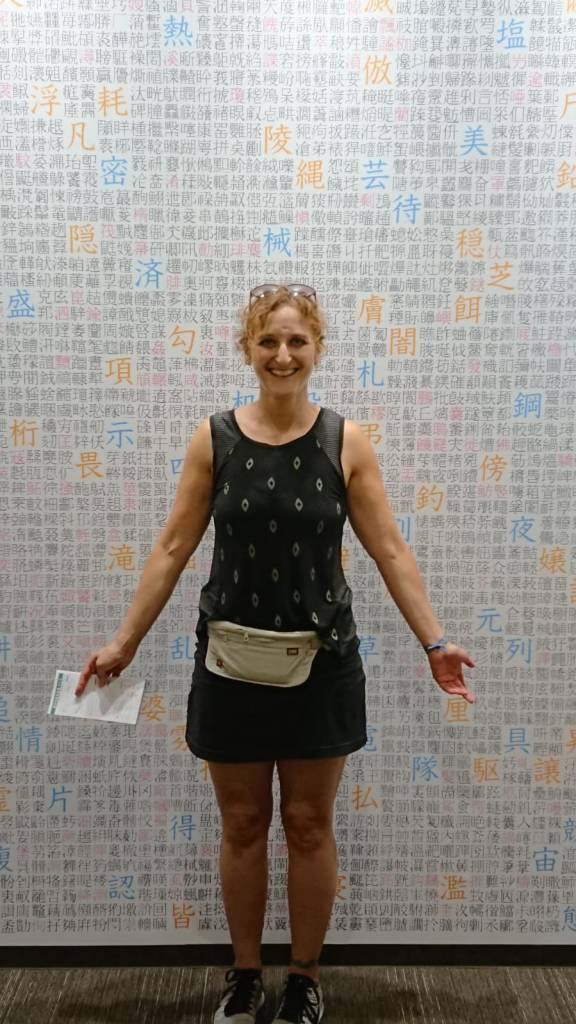
More Kanji than I will ever learn
Gion & Udon
Once the sun started to set I headed back out to walk around the Gion area. This is also known as Geisha District. If you read Memoirs of a Geisha, most of the book took place in Gion.
I wanted to go back to Gion on this trip because it was one of the most memorable places I visited the last time I was in Japan. It has a mystery about it that is both beautiful and compelling.
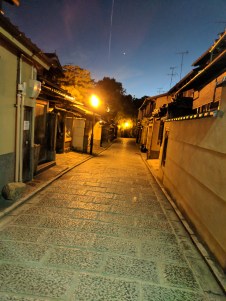
Many of the buildings in Gion are preserved historical structures that now function as restaurants. It’s a popular tourist area, but occasionally you can turn down a side street and escape the hustle and bustle. The sound of cicadas takes over and though the restaurants are all open, there are no neon signs or pictures of food. Shops might have a lantern and some curtains at the entrance and sometimes a tiny bowl of salt on the step near the entrance. If you peek in from the street, you may not see any people at all, or you might see some shadows of movement and hear muffled conversation. This is the feel I wanted to experience again walking in Gion.
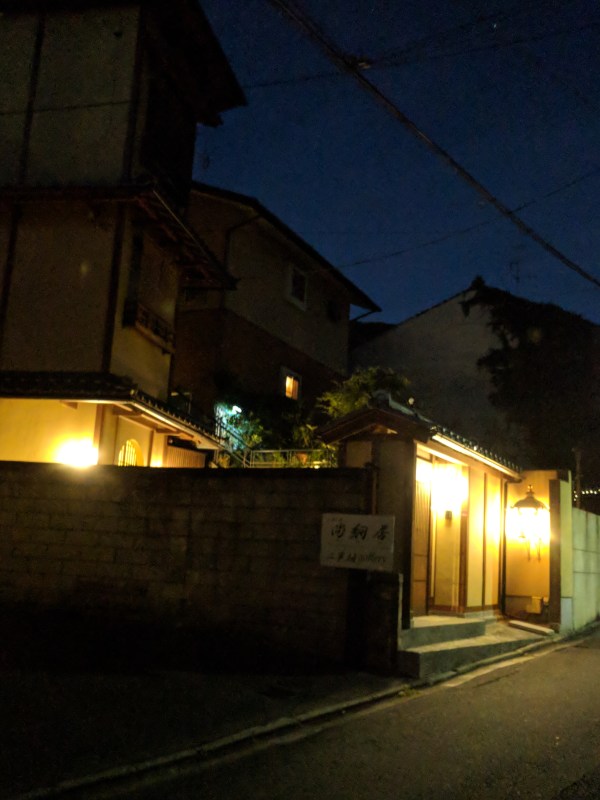
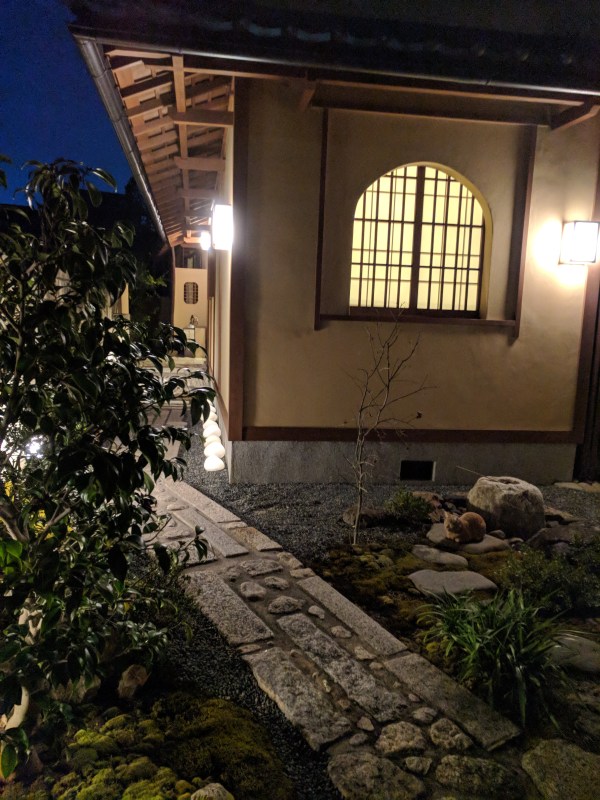
Walking back to the Kiyomizu area from Gion, I took many side streets. Most of the tourist shops had closed so the streets were fairly empty. The temperature was a bit cooler without the glaring sunlight. I stopped at a noodle shop for a beer and some cold udon and then walked the quiet streets back to the Ryokan.
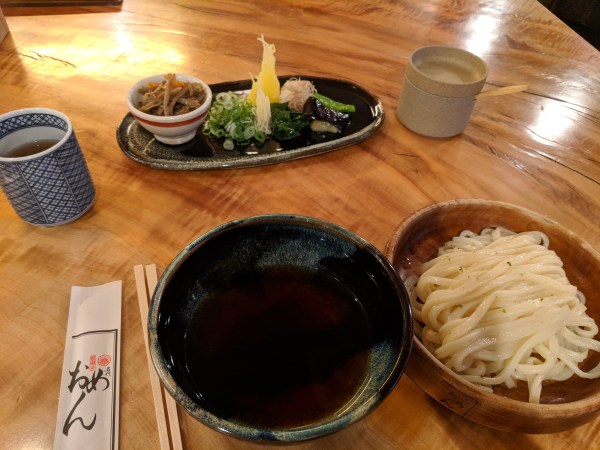
Sake & Conversation
Back at the Ryokan, the innkeeper, Raito, asked if I wanted to get a sake sampler before my bath. I decided to give it a try and he opened up the kitchen/dining area and poured me 3 different kinds of sake to taste. He stayed and chatted with me while I drank. We spoke in a mix of Japanese and English.
We talked about travel, tattoos, drinking and anime. I mentioned that I had watched Death Note and he pointed out that his name is Raito, who is the main character in Death Note (“Light” in the American translation). He told me, “I see Ryuk behind you”. If you watch the show you know what I’m talking about.
Ryokan link: http://www.sangen.info/en/
Nighttime bath
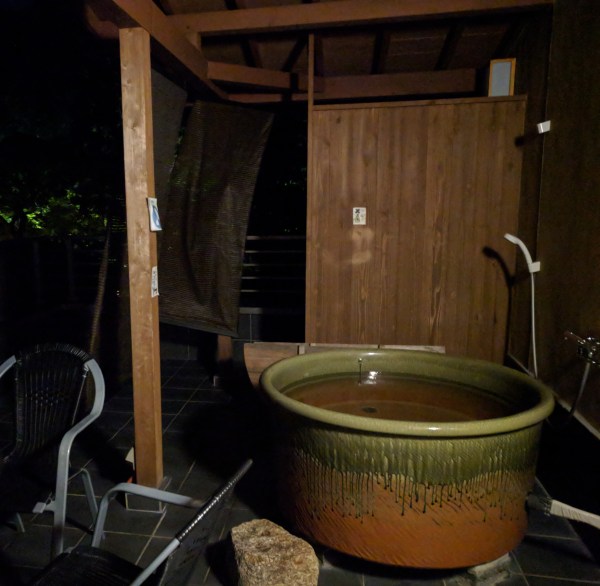
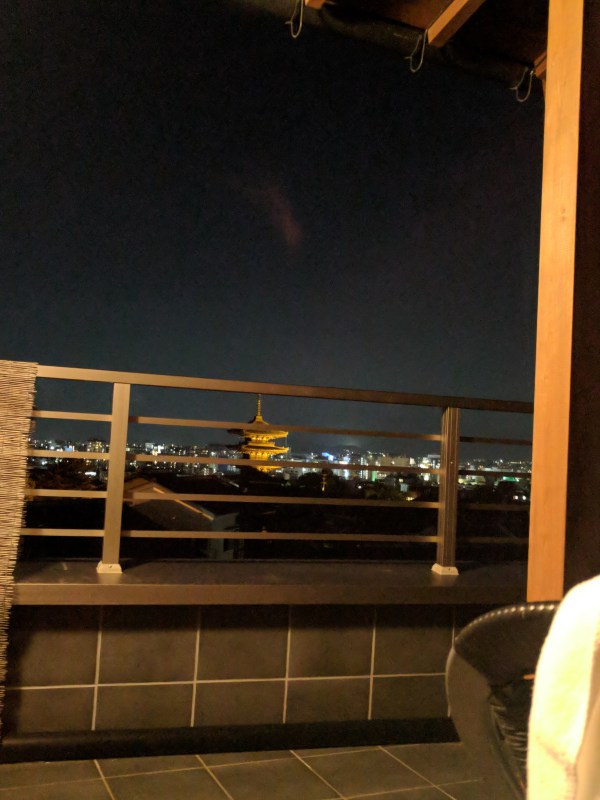
After sake, I had reserved the top floor outdoor bath with a spectacular view of Kyoto. The pictures speak for themselves.
- Posted in: Uncategorized
 origamiunicorn